
TL:DR — How do you identify the inter-related elements in a system and the way information and energy flows between them? From that, how do you identify the areas of greatest influence and/or impact where you can shift the system?
Systems thinking allows people to make their understanding of social systems explicit and improve them in the same way that people can use engineering principles to make explicit and improve their understanding of mechanical systems. – Daniel Aronson
A business is a complex organization, built on a combination of people, processes and “stock” (any constructive elements that can be counted/utilized, be it tangible (physical products) or non-tangible (knowledge/research/ideas)). What ties these together is the “relationships” that exists, connection points that enable a flow of energy — it’s these relationships that create the system in which we operate.
When working through a complex problem, the first step is to investigate: what are the systemic elements that are influencing the situation to be what it is? [I’m going to share a few models later that can be utilized for this step for those that aren’t already experienced with systems thinking processes] Once the system has an understood framework, the next element is it get clear on what the desired outcome is. Then, from that understanding, the next step is to identify leverage points where the team can influence the system towards the desired outcome. The next obvious step is to create action – from the identified leverage points, what might we do? Then, do it. Finally, after an appropriate amount of time (depending on context, could be a week, month, or 3 months), evaluate the efficacy of the interventions and determine if further change is necessary.
Understanding the System
All models are wrong, but some are useful. –George Box
There’s no single correct way to analyze and break down a system. Ideally, you’ll begin with a level of understanding of what you’re trying to do, and use that to guide you in determining a model that is of value.
For example: one way to model the system that is Global, through the lens of “how do we improve our sales performance?” is to evaluate the components of Global that contribute to this. For example, looking at the silos that define who-does-what:
- Marketing
- Product
- Sales – POS
- Sales – Payments
- Enablement
- Training
From these silos, the next question is: how do they relate? (The following statements are “ideals” – I know they aren’t 100% accurate)
- Marketing attracts possible customers (creating connection between customer and sales)
- Product makes solutions for the needs of possible customers (creating possible connection between customers and the company)
- Sales converts the leads from marketing and connects them with the solutions created by product (fulfilling the connection between customers and the company)
- Enablement helps marketing identify better leads, while supporting sales with ensuring they are prioritizing the right leads (creating connection between marketing and customer, and sales and the customer)
- Training ensures that the sales people understand how to communicate the value of product, and utilize the tools (such as SalesForce) that improve efficiency of the system. (strengthening connection between each division and the company)
From this really simplified system breakdown, we could then identify where the system is operating well, and where it is not: i.e. who is effectively creating the connections, and who isn’t. The next question is: for those areas where the system is not working well, what are the root causes?
“The product we have is a generation behind our competitors.”
“Marketing keep driving the wrong leads to the wrong team, wasting time.”
“How many of the sales people are actively making calls and pulling doors every day?”
“What does enablement actually do, other than add new processes and busywork?”
“Does training even know what they are talking about?”
[I am exaggerating here, but I am willing to bet each of the above statements have been thought at some time in the past two years.]
This is where I feel like the standard “siloed-system” view of a business is not effective, because it often turns into a blame-throwing context.

If investigating the system doesn’t devolve into blame and shame, but utilizes inquiry, than this way of viewing the system does have value:
“what are the actions we are taking that aren’t getting the results we want?”
“what processes are we utilizing because of history, rather than actual value?”
“what information is not being shared effectively that could enable faster and better decisions?”
What is your model
Looking at other ways to model a business:
Systems thinking has several useful models for leaders/managers:
- Feedback loops: what are the loops that encourage action/behavior, and what are the loops that seek to push towards stability (balance)? A bonus for a sale is an encouraging loop. A headcount limit is a balancing loop. To utilize this, consider the documented processes – are they trying to drive a new/recurring behavior, or are they trying to limit an undesirable behavior/outcome?
- Time Delays: in systems thinking, it is understood that systems influencing actions can sometimes take time before showing results. For all of the processes and tools in the system you are leading — how many of them are at maturity? How many of them are at a state of “degradation” (all things in a system have a life-cycle- new things need extra support effort, things at maturity are effective, and somethings as they stand are past their useful point).
- Boundaries and Perspectives: the answer to “where does a problem begin and end” is dependent on the viewer. In a situation where two sales people are fighting over swim lanes — each sales representative is likely to assume the other person is in the wrong. Managing through a situation like this requires being able to take different perspectives, especially zooming out to a “company-wide perspective” (i.e. what team is best suited to support this type of customer today, tomorrow, and twelve months from now?)
- Leverage Points: some aspects of a system have larger impact on behavior than others. Relationships and trust are slow building “stock”, but long-term have a significant impact on the ability to rapidly resolve conflict and work towards solutions.
Utilizing Leverage Points
The following comes from a paper published in 1997 by Donella Meadows, a leading researcher and thinker on systems thinking.
Meadows lays out the leverage points that influence large systems such as countries and communities. I’ve selected the points that are most relevant for managers and leaders to explore:
The Gain around driving positive feedback loops: putting this into plain English, how measurable and effective are the positive feedback loop initiatives. For every bonus promised, how many additional dollars are generated for the company? For every bonus trip, how many more roof-tops? Pizza parties? (I’m guessing the impact of that last one is pretty low). Training? One-on-one time with managers/leaders? Opportunities for promotion? A positive feedback loop is any behavior you do, or action the business does to “acknowledge” the desired behavior (measurement and communicating this measurement in a way that can be actionable).
How often do you measure the impact of efforts? How effective is the communication in reinforcing the behavior that is desired?
The Structure of Information Flows: It’s generally safe to assume that everyone in an organization is “doing their best, with the information they have at their finger-tips.” Just because information exists within the organization, doesn’t mean that the people who should be guided by it have easy access to this information. One of the biggest causes of conflict in large organizations is rooted in unbalanced information flows – one team is making priority choices based on the information they have access to, while another team are angry at those choices because they have conflicting information. It’s long been theorized that what will be the breaking point for organizations in the 21st century will be the difference between those that can get the right information to the right people at the right time; and those that are choking on data. AI is being promised as a solution to this; but with the rise in hallucination data, at this time, it’s not yet proving to be an effective resource to ensure QUALITY data is shared and summarized in useful ways.
What information do you have easy access to that other teams need to be aware of in setting their priorities? What information do other teams have that you need to set your priorities? How effective is your current system at sharing that information in ways that are actionable?
The Rules of the System: pay structure, performance metrics, swim lanes, etc. These are often leverage points that are assumed to be fixed — this is how we’ve always done it. The opportunity here is to consider a deeper “why” — why this team, at this time? The rules of operation can be difficult to change (because many folks will resist this type of change), but they are a powerful leverage point.
Why does your team do what they do, when they do it? What assumptions are baked into your answer (i.e how much of the answer is based on up-to-date analysis, and how much is based on past performance)?
The Mindset of the system: mindset is crafted from the combined beliefs and assumptions of everyone involved in the company. Mindset is how companies like Apple have had the success they’ve had — there is a collective belief around trying and attempting something different. There isn’t fear to harm an existing product when the potential of a new product is much bigger. At Global, there has been a lot of shifting of mindset because of the incorporation of many other businesses. What you and your team believe in drives the goals you set, and how you achieve them. Those beliefs inform how you measure progress. They shape how you communicate. It’s probably the most impactful level, but also the hardest to move.
One more model
Aaron Dignan, in his book Brave New Work lays out an “operating system” for a modern business that is useful in this systems thinking context:
- Purpose: how do we orient and steer?
- Authority: how do we share power and make decisions?
- Structure: How do we organize and team?
- Strategy: How do we plan and prioritize?
- Resources: How do we invest our time and money?
- Innovation: How do we learn and evolve?
- Workflow: How do we divide and do the work?
- Meetings: How do we convene and coordinate?
- Information: How do we share and use data?
- Membership: How do we define and cultivate relationships?
- Mastery: How do we grow and mature?
- Compensation: How do we pay and provide?
For each challenge you are working through, you’ll likely only need to consider two or three of the above. But this is a useful framework for considering where you can have the best influence (and where you’re going to have the greatest resistance).
Putting it into action
…systems thinking also needs the disciplines of building shared bision, mental models, team learning, and personal mastery to realize its potential. Building shared vision fosters a commitment to the long term. Mental models focus on the openness needed to unearth shortcomings in our present ways of seeing the world. Team learning develops the skills of groups of people to look for the larger picture beyond individual perspectives. And personal mastery fosters the personal motivation to continually learn how our actions affect our world. — Peter Senge
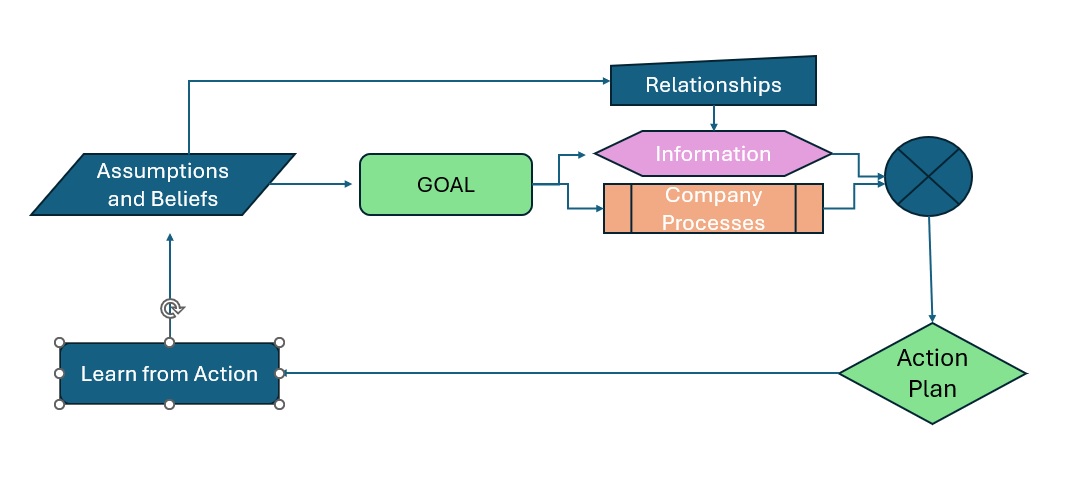
When a goal is defined (either by you, or your leader) — what are the assumptions and beliefs that are defining this as the most important goal for you to be pursuing? From that, investigate what information you have regarding the system — Why is it what it currently is? What will need to be different? What are the aspects of the system that will resist change? What aspects of the system will support the change? What company processes are driving the current situation? Who owns that? What relationships are going to be critical to ensure the right people have the right information at the right time? What relationships might impede the desired change? (I could go on…).
Then, as always — make a plan of action. Take action. Measure the results — how does it align with previous assumptions? Does the goal still stand? How are the relationships being impacted by this action? Does this action plan still make sense, or is there new information to encourage a change?
 Jim Mondry Coaching