
There are two types of work products:
1–This will work
2–This might work
THIS WILL WORK
“This will work” tasks are known, understandable, and predictable. A sales methodology is a “this will work” type of situation — you know that if folks follow through on their commitments, that success will come.
These are situations where “managing” is really useful.
A “manager” is someone who directs the work of others and who sets priorities and expectations for performance. The tasks of managing are: measurement, analysis, and communication.
We begin by measuring performance — how granular depends on your level of management. Lower levels of management might want and need to measure the efficacy of every step in a process. Higher levels of management will be measuring outcomes and adherence to policy. You know what you need to measure to understand if your team is doing a good job. The question is — do the tools you have access to allow you to accurately measure and understand the quality of the work your team is doing?
After measurement, you need to look at the data gathered and create a meaningful story. This story is going to help inform you — what should continue, what should stop, what needs to be changed, and what should start.
Finally, as a manager — you’re going to communicate this story to your team. At best, you’ll use this as a collaborative effort, showing the data you’re gathering to your people and inviting them to collaborate with suggestions on making meaningful changes. Sometimes, you may need to dictate the changes necessary (either due to your team’s lack of experience, or if there’s a sudden pressure to implement immediate change).
The quality of your skills as a manager are made up by how you assess performance, and turn that into opportunities for improvement.
THIS MIGHT WORK
“This might work” tasks have some level of uncertainty. Perhaps there is question around the best changes to make, or maybe the desired outcomes are poorly defined. Often, when initiating any “innovative” task/process — there are “unknown-unknowns” that can slow down progress or show that the change effort is not going to be effective.
These are situations where “leadership” is much more impactful.
There are SOOOOOOO many models of leadership. There are two I find most useful.
Intention-based leadership.
“[Leadership] is the art of releasing human talent and potential.” – David Marquet
My favourite book on Leadership is Turn the Ship Around, by David Marquet. It shares Marquet’s shift from being a traditional Navy leader, one who controls and dominates, to one who has learned how to elevate and inspire commitment. The biggest take away for me, was the idea of “I intend…”
Traditionally, ‘managers’ would tell someone what to do for their role to be successful. In order to not be a micro-manager, some people do the exact opposite, and do not give any direction. The middle ground is to ask your people “What do you intend to [do/prioritize].” By asking this question, you can then understand what your employees feel is important. If you are in alignment, there’s nothing to be done. If they share an intention that you don’t feel aligned with, then you can share information or ideas with them that might change their priority. Or, they might be able to share with you something that changes your perspective. The key is — having an open dialog about commitments, and why those commitments are being made.
In context of “this might work” tasks — an employee then has the freedom to determine what they will prioritize, and shares that with you (the leader). Your job is to then be a rudder, making sure their effort is aligned towards a shared goal.
Skills needed for this type of leadership:
- Setting clear expectations — by having clearly defined goals (WHAT and WHY), you give space for your team to figure out the HOW.
- Coaching — there will be times when the HOW is unclear/uncertain. Supporting your team through dialog, to identify the “best path, today”, ensures that you are leading your folks forward
- Patience and comfort with uncertainty — i.e. Emotional Intelligence around difficult emotions at work.
Co-Active Leadership Model
The Co-Active Training Institute (who I trained with as a coach and as a leader) created a specific multi-dimensional model of leadership:
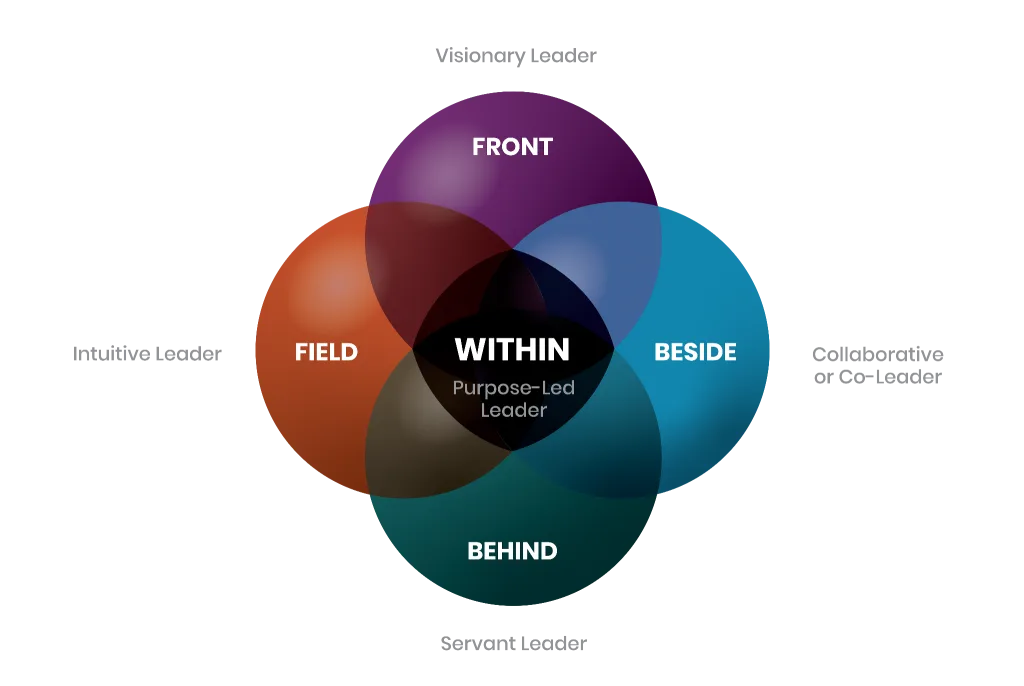
Without trying to cram a 3-day, and a 10 month program into this post, here’s the high-level ideas I want to invite you to consider:
- Leader Out Front — a leader out front creates a vision for “what is possible” and invites others to participate in making it a reality. How strong are you at creating a vision for a future that you are motivated to create? How confident are you at enrolling others to help make that vision possible?
- Leader from Behind — Leading in this dimension is to “have someone’s back”. You help with coaching, encouragement, and creating a safe space for when things are difficult. If you are in the process of developing any of your people to become stronger leaders, this is the dimension to embody when working with them. For the sake of our conversation, I’m not sure this is the most important to consider
- Leader from Beside — In this context, the idea is “how do we share the effort at prioritization and action?” This is a collaborative place, involving a lot of listening, trust and communication. This is a useful dimension to consider when you are partnering with another group who might have different priorities that you have. How do you hold the “both-and” of this type of situation?
- Leader from the Field — This is a bit esoteric, and I’m not going to go into it here.
- Leader from Within — For anyone who is acting in a leadership role, your effort begins from within you: connecting to your strengths, your values, your resilience and your ambitions. The more you know how to intentionally connect with these aspects of yourself, it makes it easier to bring forward a different type of effort. This effort, shaped by your attitude and your positive energy influences how others experience you, which makes it either easier or harder to want to work with you.
How is your ability to “cast a vision” for what’s possible? How is your ability to invite others into making this vision a reality?
How well do you share relevant information, understanding the difference between “signal” and “noise” when working with other leaders?
What is your method of connecting to your “best self” (your aligned strengths, values, resilience and ambitions)? How do you then use that for guiding your team and partners?
 Jim Mondry Coaching