
Humans do not like uncertainty and change. We just don’t. One of the foundational questions all spiritual traditions wrestles with is: “how do we live with change?”
I begin here because I want to make it clear — there isn’t an “easy”, “fun” or “energizing” path to dealing with uncertainty and change. Not for your team, and not for you.
And, we all have to live with it.
Beginning with the leader
The first step in developing skills for Leading through Uncertainty and Change, is to understand your own “set-point” for these experiences. For those who’ve done a Hogan assessment — you’ll want to look at that (I’m not trained in Hogan, so I’m not sure what specifically to call out, but I know that will be in there).
The Personality Tool I have trained with is PrinciplesYou. If you have not done a Hogan assessment, I do recommend spending the 30-45 minutes with PY. I can help you debrief the information if you want.
In PY, they break out one aspect of how you think into a category of Creative, with sub-categories of Originality, Curiosity, and Nonconformity.
Those who score high on Originality, Curiosity and Nonconformity are naturally going to be much more comfortable with Uncertainty and Change. Your Curiosity will help you navigate through the information you are able to assess, your Originality will support you in making guesses and trying unproven ideas, and your Nonconformity will help you in challenging authority in pursuit of what you believe is the best path forward.
- How comfortable are you with trying new solutions to problems?
- How comfortable are you with taking action when the complete path to the goal is unclear?
Within the “How You Think” category, another characteristic is Deliberative (how you process information to make decisions, solve problems and complete tasks). Higher scores in this category suggest you are someone who likes to take your time to consider the complex factors, create systems, and use logic to come to conclusions. This aspect is important to understand, because those who are “lower” in deliberative may not communicate through Uncertainty and Change as easily as those who are higher.
From the PY system, there’s one more category I want to highlight: Composed. Some folks are quick to react to an emotional stimulus. Others are able to slow their reaction down, and respond. In any situation of Uncertainty and Change, there will be times when you receive difficult information. If it’s from your leader or higher–sometimes it’s “easier” to stay contained in the moment, but that strong emotion will influence how you’re able to find effective ways to lead through this new context. When it’s information from your team (ex. a big deal just fell through) — your balance is important in helping your team move forward towards the next opportunity. This is partially an Emotional Intelligence characteristic (i.e. you can learn how to become more composed); but it’s also a personality trait (your biology is just wired a certain way). I raise this hear, because Leading through Uncertainty and Change will naturally have times of mistakes and misses. The best way to help your team is to ensure they see what they have influence over, and where they can make a positive impact going forward — but in order to do that, EVERYONE will have emotions they are working to manage.
- How well do you manage disappointment or frustration with your leader?
- With your team?
- How effective are you at helping your team identify the tasks and situations where they have the most opportunity for a positive “next” step?
Making the Complex “Simple”
I was recently reading an old article in a magazine titled ” The four x-factors of exceptional leaders.” The first x-factor in the article is: “They simplify complexity and operationalize it.” My immediate reaction was… to think the authors had a lobotomy. On the surface (first read), it felt like the worst of “work-place jargon.” Maybe they’re just good at “pivoting” and “putting a pin in it”.
After sitting with the point for a few days, my brain reframed the idea: in a situation of ambiguity, complexity and uncertainty, your team NEEDS to know what is the most important work they should be focused on. As a leader, sometimes the most impactful thing you can do is to look at the mess of information, and choose to make a “story” out of it. YOU CHOOSE what is relevant and what isn’t. Yes, you may be wrong — but by relying on your experience, your intuition and your positive intent, what is most likely to happen is that your “wrongness” just was slightly misdirected which can be corrected later when you have better data.
You’re not “making the complex simple” by throwing out reality. What you are doing is connecting the dots in a way that enables your team to see what they need to see, giving them a chance to take clear and aligned action.
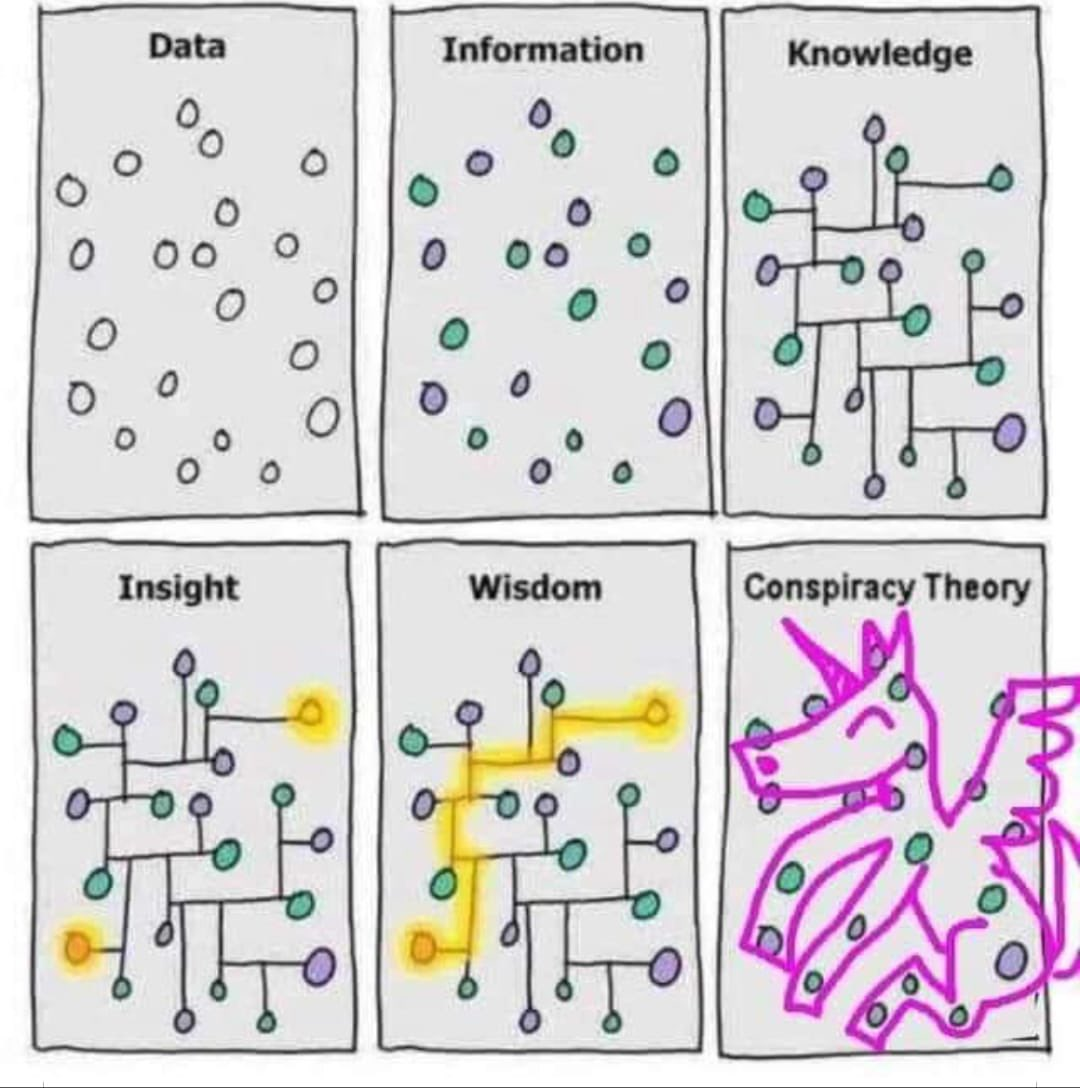
(Image credit — I’m pretty sure this was originally from the comic XKCD)
Recognize that sometimes your job is to help turn data into information. Or show the connections that lead to knowledge. And try to stay away from conspiracy theories.
- Tell me about a time when you had a lot of confusing data, and you had to determine what was relevant, and then how you turned that into a plan?
Do you have a strategy, or a plan
Most people in leadership have competence with crafting a plan.
Step A; Step B; Step C; Repeat
Plans are really useful when working with certainty. You can anticipate risks, challenges and opportunities.
A strategy is a little more vague. A strategy begins with a clear outcome in mind. A “What”, and a “Why”. Then, as the team is perusing actions towards that outcome (the HOW) — rather than dictating actions, you can share critical values to evaluate which actions might be worth trying. For example: A leader might be given the challenge to reduce their operational expenses by 10%. That’s the What. The immediate question begins with “how might I cut costs?”
A plan, would dictate the “how” — I’m going to cut labour by X%, and our bonuses by Y% and our travel budget by Q%.
A strategy would look at (possibly): “where are we getting the best return on our investment?”
An alternative strategy might ask: “given the goals for the next 12 months for the team, where might I make cuts that have the least negative impact on those goals?”
A good strategy is intended to create options. Personally, I find the best ones come from an interesting question (but that is purely an opinion). It lays out the values you want to protect, and then invites curiosity around how to balance the complexities of reality, with the possibility of your own creativity in coming up with solutions. And, when you hit road-blocks, you’re not stuck. You just have to revisit your strategy and ask “from here, how do I respond?”
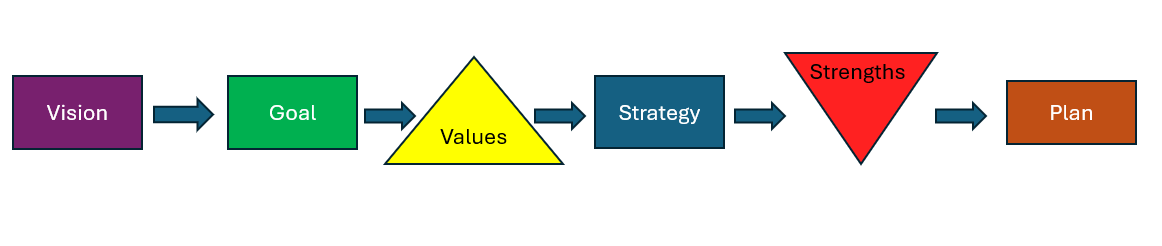
In summary:
- Humans don’t like uncertainty and change
- Some folks are “wired” to navigate it easier — consider your own set point
- There are two aspects of “managing” uncertainty and change — the tasks to be done, and the emotions felt by you and your team
- Leading through uncertainty and change will require you to make educated guesses, and then communicate those to your team, clearly and concisely, so they know what’s important
- Plans change as the situation evolves. A good strategy helps you see when it’s time to adapt, modify or abandon the plan.
 Jim Mondry Coaching